Latest News

Latest News

Dr. Frank Mitloehner Speaks at 30th UNECE Seminar on Meat

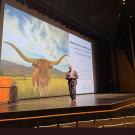
Dr. Frank Mitloehner speaks to international audience at the United Nations Economic Commission for Europe Seminar on Sustainable Meat and Livestock Production on the path to climate neutrality for beef and dairy production.

CLEAR Center Director Frank Mitloehner Speaks with Irish Oireachtas Committee on Methane

Dr. Frank Mitloehner, CLEAR Center director and UC Davis professor and Cooperative Extension air quality specialist, joined University of Oxford professor of physics, Dr. Myles Allen, and other climate scientists to testify at a special meeting of the Irish Joint Orieachtas Committee on Agriculture, Food and the Marine. The meeting focused on how methane emissions – including those from animal agriculture – should be considered and calculated by the country.

Dr. Frank Mitloehner guests on Food Chain Chats Podcast

CLEAR Center Director Dr. Frank Mitloehner joins host Andy Vance on the Food Chain Chats podcast where they discuss sustainability in livestock farming, rethinking methane — from liability to asset with proper management, and the importance of farmers communicating what they do and why they do it. 

UC Davis students campaign to change mascot from horse to cow

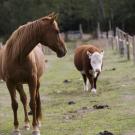
Recently UC Davis students voted to change the University's mascot from Gunrock the horse to a cow. The campaign acknowledges the importance of agriculture to the school's identity. CLEAR Center Director Dr. Mitloehner is quoted in an article by Sahalie Donaldson in The Chronicle of Higher Education which details the campaign and its impetus, as well as hurdles to actually changing mascots. 

Agriculture can play ‘powerful’ part in reducing greenhouse gases, speaker says

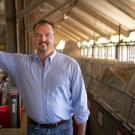
MANHATTAN, Kan. – A University of California, Davis professor who has spent nearly two decades studying the relationship between the livestock industry and air quality told a crowd of nearly 800 at Kansas State University Monday that agriculture can be a powerful part of the solution in reducing greenhouse gases in the atmosphere. 

A new study from Dr. Frank Mitloehner’s lab at UC Davis looks at reducing enteric methane using essential oils

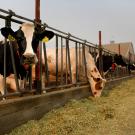
Whether or not you subscribe to the ability of essential oils to ease your stress, lighten your mood or give you a feeling of calm, it’s worth taking a look at how some of them are being used as feed additives that reduce greenhouse gas emissions of cattle. A team at University of California, Davis, under the leadership of Frank Mitloehner, Ph.D., published a paper in October 2020, studying Agolin® Ruminant (AGO) and its ability to do just that. The Mitloehner Lab found an 11 percent reduction in methane intensity.

The climate impacts of methane are overstated, according to a review of new research

A review of new research suggests the climate impact of methane is not accurately reflected because current metrics don’t recognize that it breaks down in the atmosphere over the course of 12 years. Other greenhouse gases (GHGs), such as carbon dioxide released from the burning of fossil fuels, can remain in the atmosphere for hundreds of years.