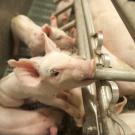
The CLEAR Center at the University of California, Davis has begun a partnership with the National Pork Board (NPB) to further sustainability research and extension in swine production. The CLEAR Center, led by Dr. Frank Mitloehner, leverages world-class research and science communication to improve sustainability in animal agriculture.
CDRF and UC Davis CLEAR Center release a new analysis of methane reduction in California dairy. The paper, authored by researchers at the UC Davis, concludes that the sector can reduce methane by 40% by 2030 with aggressive mitigation efforts..
New study published in the Journal of Dairy Science from Dr. Frank Mitloehner, Conor McCabe, and Dr. Sara E. Place outlines a path for the U.S. dairy industry to reach climate neutrality as soon as 2041.
Mitloehner lab study tests potential of Zoetis' Actogain 45 to reduce ammonia emissions in feedlot steers and finds the RAC supplement able to reduce emissions in addition to improving animal performance.
One percent a year. If the California dairy sector can reduce its methane emissions by that amount, it could reach net-zero warming in a decade’s time.
Within the next 30 years, the U.S. beef and dairy sectors can reach climate neutrality through considerable reductions in methane emissions. New white paper from the CLEAR Center and Elanco details how.
Whether or not you subscribe to the ability of essential oils to ease your stress, lighten your mood or give you a feeling of calm, it’s worth taking a look at how some of them are being used as feed additives that reduce greenhouse gas emissions of cattle. A team at University of California, Davis, under the leadership of Frank Mitloehner, Ph.D., published a paper in October 2020, studying Agolin® Ruminant (AGO) and its ability to do just that. The Mitloehner Lab found an 11 percent reduction in methane intensity.
UC Davis White Paper Re-Examines Methane’s Role in Climate Change, and How California Dairy Can Achieve Climate Neutrality
DAVIS, Calif., Sept. 2, 2020 – Researchers from the University of California, Davis are rethinking methane and showing that climate neutrality is within reach for the California dairy sector.