



New World Screwworm: What U.S. Livestock Producers and Consumers Should Know
For nearly 60 years, New World screwworm was largely a problem of the past for the United States. That changed in 2026. In June, the U.S. Department of Agriculture confirmed New World screwworm in cattle in South Texas, the first confirmed U.S. livestock detection in decades.
The detection followed a northward expansion that began when New World screwworm moved beyond the biological barrier in Panama in 2023, spreading through Central America and reaching Mexico in 2024. Its continued movement north prompted restrictions on livestock entering the United States from Mexico and intensified surveillance along the border. By 2026, cases had been detected in Texas and New Mexico.
For the latest case counts and locations, visit USDA’s Detection Dashboard.
The California Department of Food and Agriculture (CDFA) reports no confirmed detections of New World screwworm in California. State officials are working with federal and neighboring state agencies to monitor the situation, including through fly trapping along California’s borders, and are implementing additional animal-entry requirements to help prevent its spread.
For livestock producers, the return of New World screwworm is a serious animal-health and economic concern. For consumers, however, it is important to understand what it is, and what it is not. New World screwworm is not a foodborne pathogen, and eating beef is not a route of transmission. Its potential effects on consumers are indirect, primarily through animal health, cattle movement, trade and livestock supply.

To understand why the New World screwworm matters to the U.S. cattle industry and consumers, it helps to first understand what it is, how it affects livestock, and why preventing its spread is so important.
What Is New World Screwworm?

New World screwworm (NWS, Cochliomyia hominivorax) is a species of blowfly that lays its eggs in wounds or body openings of warm-blooded animals. The eggs can hatch within 12–24 hours, producing larvae, or maggots, that burrow into the wound and feed on living tissue. The name “screwworm” comes from the way the larvae burrow deeper into tissue as they feed, resembling a screw being driven into wood. The larvae typically feed for several days, causing progressively greater tissue damage as they mature. Without treatment, severe infestations can become life-threatening.
This type of infestation is known as myiasis.Once mature, the larvae leave the animal and drop into the soil, where they develop into pupae before eventually emerging as adult flies. Unlike many other fly larvae that feed on dead or decaying material, NWS larvae feed on living tissue, which is what makes this parasite particularly damaging.
What Does an Infestation Look Like?
Screwworm infestations are often smelled before they are seen. Infested wounds can develop a foul odor, particularly when secondary bacterial infections occur. Wounds may be painful, swollen, bleeding, or draining, with larvae visible near the surface. The larvae are about the length of a grain of rice and range from white to yellow, with two distinctive dark internal lines extending from the rear of the body toward the head. Hair or fur can make an infestation difficult to see, and severe infestations may become inflamed and extend deep into the affected tissue.
Why Is the New World Screwworm Such a Big Concern for Livestock?
New World screwworm can infest any warm-blooded animal, including livestock, pets, wildlife, and, in rare cases, humans. Cattle, horses, dogs, and other animals with open wounds or exposed, moist body openings are particularly vulnerable because female flies seek these sites to lay their eggs.
For cattle, even small or routine wounds can provide an opportunity for infestation. A newborn calf’s healing navel, wounds from branding, disbudding or dehorning, tick and insect bites, scratches, injuries, and surgical sites can all provide potential sites for egg laying. Natural body openings and moist areas, including the mouth, vulva, and perineum, may also attract female flies. As a result, even an otherwise healthy animal can be vulnerable.
For livestock producers, the consequences can extend well beyond the affected animal. Infestations can worsen quickly, causing extensive tissue damage, secondary complications, and potentially death. If New World screwworm becomes established in livestock populations, producers may also face increased treatment and management costs, production losses, additional surveillance and biosecurity measures, and restrictions on animal movement. Movement is particularly important because an infested animal can transport the parasite into an area where it was not previously present.
Prevention and early detection are therefore essential. Producers should monitor animals for suspicious wounds and report potential infestations to animal-health officials. Inspections, treatment, identification, certification, and other animal-movement requirements may also be necessary to limit spread. The concern is not simply treating one infested animal; it is preventing that infestation from becoming the starting point for a new population of screwworm flies.
Fighting Flies with Flies
One of the most unusual tools for fighting screwworm is the fly itself. The sterile insect technique, or SIT, involves producing large numbers of screwworm flies, sterilizing them with a carefully controlled dose of radiation during the pupal stage, and releasing the sterile adults into areas where wild screwworm populations are present. Sterile males can still mate with wild females, but the resulting eggs do not hatch.
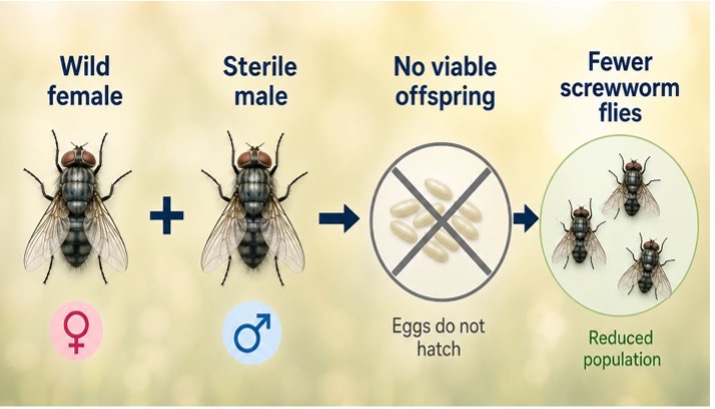
With repeated releases, fewer offspring enter the next generation and the wild population declines. This approach was instrumental in the successful eradication of NWS from the United States in 1966. Sterile insect releases remain an important part of current control and eradication efforts.
Is Beef Safe to Eat?
Yes. NWS is not a foodborne pathogen. It is a parasite of living animals, and the primary consumer concern is not contracting screwworm from eating beef.
For information about human health and screwworm, visit the CDC's New World Screwworm resources.
How Can a Fly Affect Cattle and Beef Prices?
This is where animal health becomes an economic issue. U.S. cattle supplies are already tight after years of drought, high production costs, and reductions in herd size. Although advances in genetics, nutrition, animal health, and management allow today’s cattle to produce more beef per animal, increased carcass weights have helped offset some of the effects of lower cattle numbers. Rebuilding cattle numbers takes time, leaving the beef supply more sensitive to additional disruptions.
The U.S. beef industry also depends in part on cattle moving between Mexico and the United States. When screwworm concerns lead to movement restrictions, inspections, or treatment requirements, they can reduce or delay the flow of cattle to U.S. feeders and processors. When cattle supplies are already limited, these disruptions can place additional pressure on beef availability and prices.
Screwworm alone does not determine the price of beef; cattle inventories, drought, feed costs, processing capacity, consumer demand, and international trade all play a role. However, disruptions in cattle movement can add pressure to an already limited supply.
New World screwworm is therefore more than an animal-health concern; it is also a food-system and economic issue. Protecting livestock helps protect producers, the industries that depend on them, and the stability of the food supply.
Should Consumers Be Worried?
New World screwworm warrants attention, not alarm. It is a serious threat to livestock, but the United States has successfully controlled and eliminated it before, and CDC currently characterizes the risk to the U.S. public as very low.
Livestock producers and pet owners should monitor animals for suspicious wounds and report potential infestations. People traveling to affected areas or interacting with animals should know what to look for. For most consumers, the primary concerns are the potential effects on animal health, cattle movement, trade, and the broader food system.
The Bottom Line
New World screwworm demonstrates how closely animal health and the food system are connected. An infestation that begins with a single animal can have far-reaching consequences for livestock health, cattle movement, international trade, and ultimately producers, processors, retailers, and consumers.
The priority is clear: prevent New World screwworm from becoming established in the United States. Surveillance, early detection, animal-health controls, and sterile insect releases are all critical to that effort. Protecting livestock from this tiny fly helps protect producers, consumers, and the stability of the U.S. food supply.