


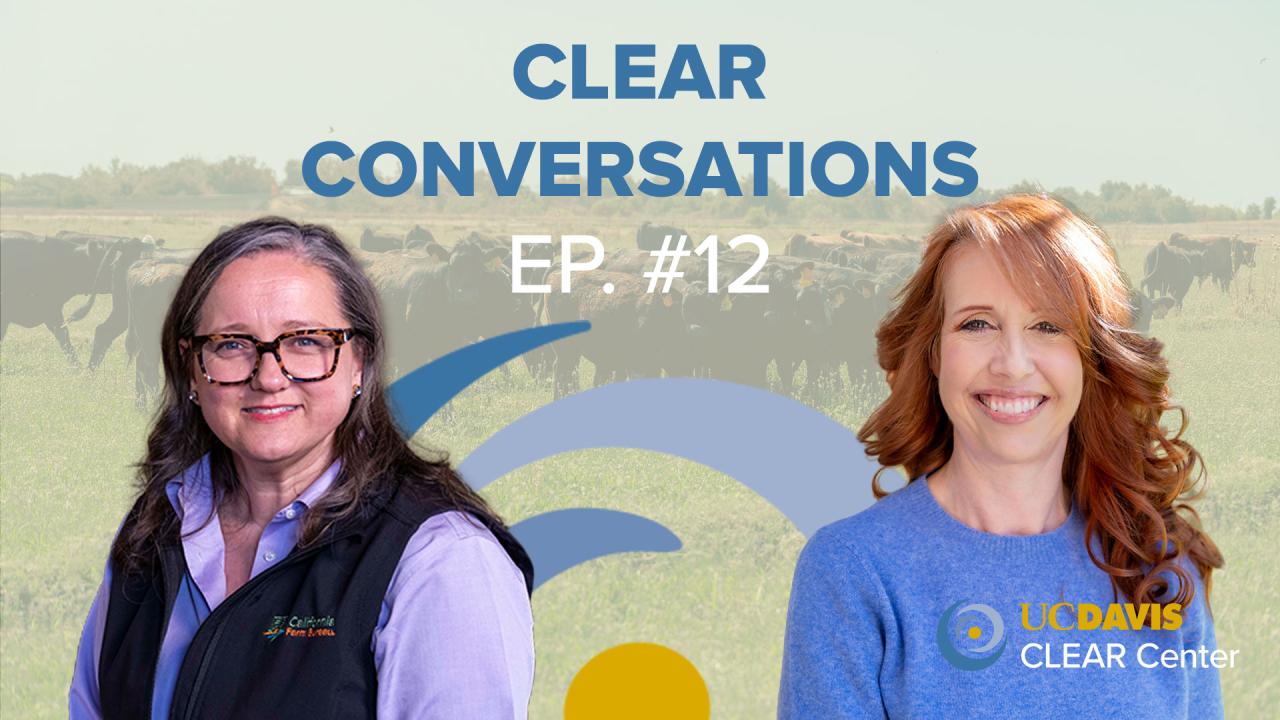
CLEAR Conversations: California Agriculture in Focus on National Ag Day
As Tracy Sellers kicks off the latest episode of the Clear Conversations podcast, at the UC Davis Beef Barn, the occasional rustle of cattle in the background offers a fitting reminder of what’s at the heart of it all: real animals, real people, and an industry that rarely gets to tell its full story. And as we celebrate National Ag Day, it’s exactly the right moment to have that conversation—about what agriculture looks like in California today, and why it matters more than ever.
That’s what brings Shannon Douglass to the table. As the first woman to lead the California Farm Bureau Federation as its president, in its more than 100-year history of the non-profit organization, Douglass represents thousands of farmers and ranchers across the state. But the conversation isn’t about titles—it’s about telling the story of California agriculture at a time when many people are more disconnected from it than ever before.
Douglass carries that milestone with humility, but her focus is firmly on the people she represents: farmers and ranchers across California navigating what she describes as some of the most intense regulatory pressures anywhere in the world. “From livestock producers to vegetable growers,” she explains, “the challenges are constant.” And yet, at its core, the mission of the Farm Bureau remains straightforward—protecting and preserving the ability of those farmers to continue producing food.
That mission begins at the grassroots level. With 54 county Farm Bureaus across the state—even in urban centers like San Francisco—the organization is built on the voices of individual farmers. When a producer encounters a problem, that concern can move from the local level to statewide or even federal advocacy. It’s a system designed to ensure that policy reflects real, on-the-ground needs.
For Douglass, those needs aren’t theoretical. She and her husband farm in Glenn County, raising beef cattle, walnuts, and forage crops. Her connection to agriculture is both personal and practical—a balance she describes as grounding. Even amid the demands of leading a major organization, returning to the farm offers clarity. It’s a reminder of what’s at stake.
That connection also shapes how she views partnerships with institutions like UC Davis. Research, she explains, plays a dual role. On one hand, it drives innovation—advancements in animal health, genomics, and production systems that push agriculture forward. On the other, it validates practical solutions that farmers have relied on for generations.
One example stands out: composting livestock carcasses. It’s not a glamorous topic, but it’s a critical one. Long practiced in various forms, the method required scientific validation to become a legally accepted tool in California. With support from university researchers, what was once informal is now recognized, giving farmers a safe, practical option. “It may not be flashy,” Douglass notes, “but it matters.”
Still, innovation often runs headfirst into outdated policy. One of the Farm Bureau’s priorities is modernizing regulations that no longer reflect today’s technology. Douglass points to autonomous farm equipment as a striking example. While self-driving cars—like those developed by Waymo—can navigate city streets, California farmers are prohibited from using autonomous tractors unless someone is physically sitting inside them. The regulation dates back to 1977, long before such technology existed.
“It just doesn’t make sense,” she says. And that frustration underscores a broader concern: California risks falling behind other states, despite being both the nation’s leading agricultural producer and a global hub for innovation and technology.
Other challenges are less about technology and more about coexistence. The resurgence of predators, particularly wolves in Northern California, has created both economic and emotional strain for ranchers. Livestock losses are devastating, but the issue is complex, intersecting with wildlife conservation and public safety. Finding solutions requires nuance and collaboration—qualities Douglass and her team are working to bring to the table.
Yet beyond policy and regulation lies another challenge: connection. Most consumers today are far removed from agriculture, and with that distance comes misunderstanding. Douglass believes bridging that gap is essential—not just for farmers, but for society as a whole.
Efforts like agricultural education programs and community outreach aim to meet people where they are. Sometimes, the most powerful moments are the simplest. A child seeing a cow for the first time at a fair. A conversation at a farmers’ market. A realization that the person producing your food is, at their core, not so different from you.
“You don’t need a big platform,” Douglass says. “Just being someone in your community who shares what you do can make a difference.”
That philosophy extends to how consumers can support agriculture. In a state that produces over 400 commodities and generates tens of billions in agricultural output each year, even small choices matter. Choosing California-grown products at the grocery store. Asking questions. Taking an interest. These everyday actions, she emphasizes, are meaningful ways to support local farmers facing mounting pressures.
Looking ahead, Douglass is encouraged by the next generation’s interest in agriculture. Programs like FFA and young farmer initiatives are drawing thousands of young people into the field. The challenge, she notes, isn’t sparking interest—it’s sustaining it, especially during difficult economic cycles.
That’s where mentorship becomes critical. By connecting aspiring farmers with experienced ones, the Farm Bureau is helping build pathways into agriculture that are both practical and personal. These relationships—rooted in shared goals and real-world experience—can make the difference between someone leaving agriculture or finding a way to stay.
In many ways, that idea of connection—between farmers and consumers, is a reminder that agriculture isn’t just about producing food. It’s about people.

Listen to past episodes of CLEAR Conversations
Missed an episode of the CLEAR Conversations Podcast? We've got you covered--all episodes of the podcast are available to listen to on Podbean. Listen and be a part of the conversation!