


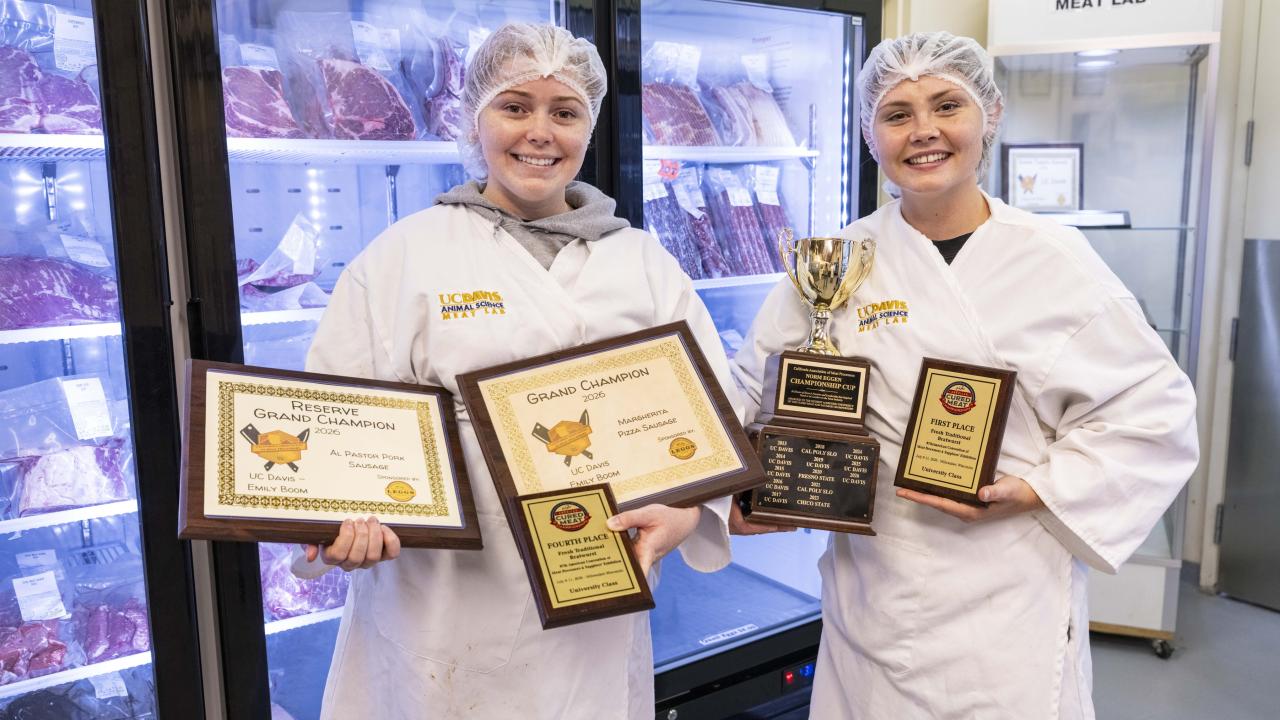
UC Davis Meat Lab Students Turn Hands-On Experience into National Honors
Hands-on learning paid off in a big way for two UC Davis students at this year's American Association of Meat Processors (AAMP) annual convention in Milwaukee, Wisconsin.
Representing the UC Davis Meat Lab and the Department of Animal Science, undergraduate Animal Science students Emily Boom and Julia Dumont competed in a competition at the convention against students from universities across the country, bringing home awards and recognition for UC Davis.
“Emily and Julia competed in the American Association of Meat Processors cured meat contests, and they entered the collegiate contest, which was a bratwurst class—38 entries, universities from all over the country,” said Meat Lab Manager Caleb Sehnert. “Julia got first place, and Emily got fourth place.”
The American Association of Meat Processors is North America’s largest meat trade organization. AAMP represents more than 1,600 meat, poultry and food businesses across the United States, Canada and several other countries, providing members with education, regulatory support and opportunities to connect with others in the industry. The competition at the convention highlighted technical skills, product development and quality standards required in the meat processing industry, giving students an opportunity to put their knowledge and skills to the test on a national stage.
Boom and Dumont put in a considerable amount of time developing and refining their competition products, bringing the same commitment to their work at the Meat Lab.
“They've spent months working on these and are super dedicated student employees,” Sehnert said.
Their success in Milwaukee is just one example of the practical experience students gain at the UC Davis Meat Lab.
“The meat lab is an important part of how we connect science with the realities of agriculture because it gives our students and researchers an opportunity to take what they learn in the classroom and apply it to real food systems,” said Dr. Frank Mitloehner, Chair of the Animal Science Department. “Ultimately, that connection between science, students and agriculture is what makes this kind of work so valuable.”
For all that value, the Meat Lab still remains a bit of a hidden gem. Tucked along the southern edge of the UC Davis campus, the federally inspected, 5,000-square-foot facility serves as a classroom, research facility and working meat-processing plant. Inside are processing and cutting rooms, an analytical laboratory, classroom space and freezers.
Sehnert manages the Meat Lab's daily operations while also teaching. Students receive practical training in slaughter, fabrication, sanitation and further processing through Animal Science courses and internships. Approximately 20 students work in Meat Lab courses during most academic quarters.

That experience extends well beyond the classroom. Students have the opportunity to participate in many of the steps involved in turning livestock into food products, from processing and fabrication to product development and quality control. The Meat Lab processes approximately 600 to 800 head annually across four red meat species—beef, hogs, sheep and goats—and produces products including extra-lean ground beef, pork sausage and other retail meat products. The Meat Lab also produces specialty items, including bratwurst, kielbasa, chorizo, hot links and other sausages, as well as marinated meats, rotating chicken breast flavors and flats of chicken and quail eggs are sold too.
All the products sold through the Meat Lab are a direct result of teaching and research in the Department of Animal Science. And the retail operation gives students a unique opportunity to see their work move from the processing floor to the marketplace—and ultimately into the hands of consumers.
For Boom, the combination of classroom learning and hands-on experience has also provided an opportunity to develop her own products. The sausage she is currently producing at the Meat Lab is a margarita pizza sausage—a recipe she developed herself. Earlier this year, she earned grand champion honors in the innovative sausage category at the California Association of Meat Processors Annual Convention and Cured Meat Show. Products entered in the competition are evaluated on characteristics including appearance, texture, flavor, uniformity and overall quality.
“All the products we make here are sold through our store, and the students help do everything around here,” Sehnert said. “There is only one full-time employee here at the Meat Lab, and these guys are the backbone of all the meat processing—everything that goes on here.”
The facility also serves as a research resource for faculty and students across UC Davis. Researchers in Animal Science and departments including Food Science, Reproductive Physiology, Endocrinology, Molecular Biology, Nutrition, Veterinary Medicine, Entomology and Microbiology use the Meat Lab for sample collection and other research activities.
And for students like Boom and Dumont, the Meat Lab provides hands-on experience with the skills and standards expected in today’s meat industry, giving them an opportunity to apply what they learn in the classroom in a real-world setting. This “learn by doing” approach also reflects a broader UC Davis commitment to connecting animal agriculture with science, education and industry needs. Through programs across the UC Davis Animal Science Department, students have opportunities to see how research can translate into real world application.
“It's really rewarding to see what these students can accomplish,” Sehnert said. “We're super proud of them.”