



Showing More Than Pigs: How the Dadsons Are Redefining Agricultural Education
Unlike many teenage girls her age, sixteen-year-old Karis Dadson isn’t smiling for the camera. When she’s showing pigs, her expression is intensely serious — and it’s helped make her a social media sensation. Her unwavering stare, intense focus and serious expression have become known as “resting pig face.”
It’s that very expression that caught the internet’s attention when a TikTok video of Karis competing at the 2022 Arizona National Livestock Show went viral. The video introduced hundreds of thousands of people to the teenager and her family’s life in agriculture. What viewers saw as a memorable expression was, in reality, a young livestock exhibitor concentrating on the job at hand.
“It doesn't look like she likes it,” her mother, Karalyn Dadson, said with a laugh. “But a football player isn't going to be out there smiling when they're playing.”
Karalyn thought the viral moment would be a one-time occurrence. It wasn't. The videos continued to rack up views, attracting thousands of followers curious about the serious-faced teenager and her family's life in agriculture. What many viewers don't realize is that the famous stare isn't an act. It's part of the job. For the Dadson family (Karalyn, Kyle and their twins, Karis and Krew), the viral moment became something bigger than social media fame. Through their farm, livestock shows and social media accounts, they’ve found a way to turn curiosity about a teenager’s expression into conversations about animal care, agriculture and where food comes from.
Today, the family has nearly 600,000 followers on TikTok and 284,000 on Instagram, giving them an unusually large audience for a family whose days still revolve around feeding animals, preparing show pigs and sharing the work of raising livestock.
Their reach comes at a time when many Americans have little firsthand experience with agriculture. As that distance grows, the Dadsons are demonstrating how social media, alongside traditional agricultural education, can help bridge that knowledge gap.
A family built around agriculture
Agriculture has long been part of the Dadsons’ lives, but in different ways. Kyle Dadson, who grew up without a farm of his own, developed an interest in livestock through his grandfather’s Quarter Horses and later began showing pigs in high school. After studying at Fresno State, he became an agriculture teacher at Atascadero High School, where he has spent the past two decades helping students develop practical skills and a passion for the industry.

For Kyle, agricultural education is about more than teaching students how to care for an animal or grow a crop. It is about helping them understand the role agriculture plays in everyone's life.
“I think every single person needs a basic understanding of agriculture,” he said. “Ultimately, every single human being relies on agriculture, whether they realize it or not.”
Karalyn grew up showing livestock through 4-H and FFA. When the couple started a family, they wanted to share that experience with their children. Today, the family raises and sells show pigs, and twins Karis and Krew have grown up learning the responsibilities that come with caring for animals and competing in the show ring.
“We never wanted to push our kids into it,” Karalyn said. “Luckily, it’s a passion every single one of us has, and we love it in our own way.”
Karalyn initially began posting videos to document her children’s experiences and promote the family’s show-pig business. She never expected those posts to reach such a large audience.
“I never thought it was going to turn into anything as big as what it did,” she said.
The stare that changed everything
To viewers unfamiliar with livestock shows, Karis Dadson’s expression might look intimidating or even a little intimidatingly serious. But for Karis, it reflects the concentration and determination required to compete.
Karis says the expression she has isn't an act. It is concentration.

“My intensity comes from the drive and passion that I have,” she said. “Showing is showing your intensity, showing your dedication, showing your passion in front of a judge.”
For livestock exhibitors, maintaining focus in the show ring is critical. In swine showmanship competitions, judges evaluate not only the pigs but also the exhibitors themselves. Participants must continuously watch for judges' hand signals, position their animals correctly and respond instantly to changing instructions. Making eye contact with judges is considered an unwritten rule of showmanship. Karis' now-famous expression is simply the look of a competitor concentrating on the task at hand.
“They don't see that behind the scenes, in the barn, late nights, early mornings,” Karis said. “Your intensity, your focus, your drive and your passion at that moment in time is all that they can judge you off of.”
The intensity Karis brings to the show ring is matched by the work that happens at home. Before sunrise, the Dadsons are already feeding pigs, sheep, dogs and cats, tending to a new litter of kittens and preparing for the day ahead. The routine unfolds with the precision of a NASCAR pit crew: Feed buckets are filled, water bowls replenished, gates opened and animals checked. Everyone knows where to be and what needs to be done.
And the work doesn’t end when the morning chores are finished. After school, the twins return to the farm to care for their animals, fitting those responsibilities in before dinner, homework and the rest of teenage life.
For the Dadsons, raising show pigs is a family effort built on responsibility, teamwork and daily animal care. Those lessons extend beyond their farm, too.
The Show Must Go On: How Show Pigs Are Teaching a Bigger Lesson
The viral video may have introduced a new audience to the Dadson family, but the show ring offers just one glimpse into their lives. For Karis and Krew, showing pigs is about more than competition. It’s an opportunity to develop responsibility, work together toward a goal and gain firsthand experience with animal agriculture.
Show pigs are pigs raised by young people specifically for livestock competitions. The kids are responsible for caring for their animals, including feeding, exercising and preparing them for the show ring, where judges evaluate the pigs and the exhibitors’ ability to present them. For the Dadsons, that commitment means spending a lot of time on the road. The family travels to regional, state and national livestock shows across the country, averaging more than one competition per month.
A “jackpot” show is a one-day competition where young exhibitors bring their animals to be judged. Unlike a county fair, where they may spend several days showing and participating in other events, a jackpot show is focused specifically on the animals and the skills of the young people who raise and show them.
That’s what brought the Dadsons to San Jose in the Summer of 2026, where they competed at The Stampede, at the Santa Clara County Fairgrounds. Beyond the competition, the event also offered an opportunity to bring agriculture into a highly urban area, where many residents may have little firsthand experience with livestock.

“People would be surprised to know that they’re welcome to come and ask questions,” said Salene Duarte, executive director of the Santa Clara County Fairgrounds. “The exhibitors are more than willing to answer questions and give you information, because they want you to know what they love and why they’ve gotten their kids involved in such great programs.”
Although the Dadson twins earned wins at The Stampede, for the family, the bigger reward goes beyond the banners: the responsibility, skills and experiences that come with raising and showing livestock.
A classroom with thousands of students
Today, the Dadsons’ influence extends beyond the livestock shows. Through their social media accounts, Karalyn regularly offers insight to people who are curious about agriculture but have never visited a farm or spent time around pigs. Some questions are earnest. Others are based on misconceptions. But she sees both as opportunities.
“I would rather them be genuinely curious and just not know and want to understand,” she said. “I try to be as respectful as possible.”
Her goal is to show people that caring for livestock is not separate from the family's everyday life — it is at the center of it.
“My mom, being the perfectionist, she is, she learned what people want to see,” Karis said. “….And come to find out, what people wanted was help.”

“I just never thought I'd be answering all the questions that I am and trying to help people through things,” Karalyn said. “And I wish sometimes I could just go through the phone and help people and physically go there and help them. But I definitely feel like we're trying to help as many people as we can.”
For Krew, those conversations are important because they give the family a chance to address misunderstandings about how show pigs are raised and cared for.
“I feel like the biggest misconception when it comes to show pigs is that people think we're careless,” he said. “In reality, it's maybe the exact opposite. We dedicate most of our lives to taking care of these pigs and making sure they live their best life.”
The care is visible in the daily routine. The pigs are washed, exercised, groomed and monitored closely.
“They're washed every day. They're walked every day. They're pampered better than I pamper myself,” Karalyn said with a laugh. “They definitely get brushed more than I brush my own hair.”
Karis believes the larger lesson is about agricultural literacy.
“I think there should be a foundational understanding of agriculture for everybody,” she said. “Whether you're a producer or someone buying food at the grocery store, you're part of agriculture.”
“Producers and consumers need to be able to communicate and understand one another. If we lose that understanding, those bridges are going to be burned.”
Hands-on learning with lasting impact
That gap in understanding is one reason Shelby Sopocy believes visibility matters. As animal care supervisor and manager of the Swine Teaching, Research and Outreach facility at the University of California, Davis, Sopocy works with students in swine production and sees firsthand how show pigs can help bridge that gap “Over the last 10 years, show pigs have really become the vehicle for young people to get hands-on experience with swine.”
She added that, “Show pigs open the door. And broaden their horizons as to what’s available in terms of careers in animal agriculture.”
At UC Davis, students gain practical experience in animal care, nutrition, health, breeding and herd management — skills that also introduce them to the challenges of modern pork production, including animal health and responsible resource use.
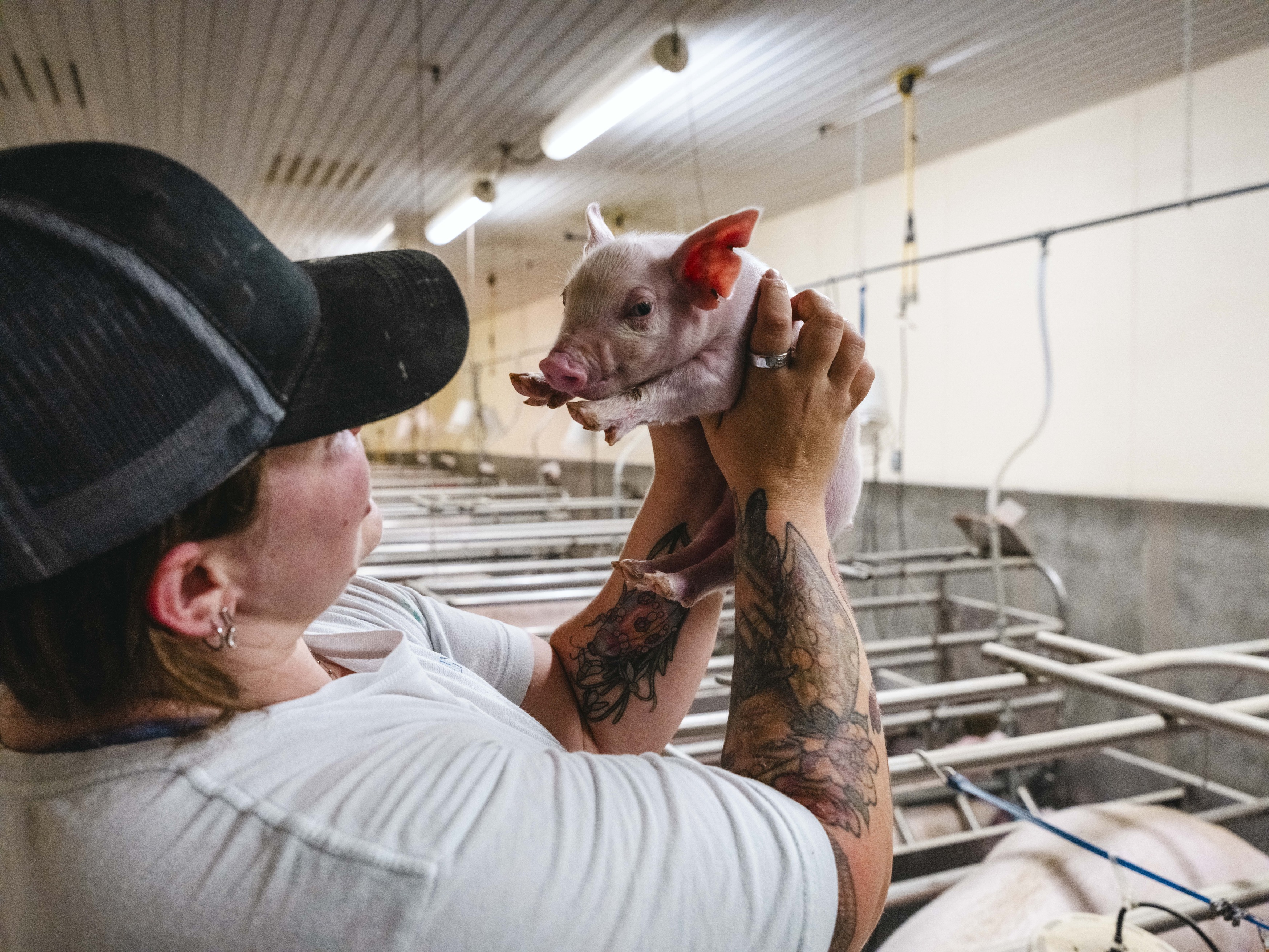
“The goal of the UC Davis swine facility is to provide students with a positive, hands-on experience,” Sopocy said. “Instead of only learning about production in a classroom or a textbook, they get to be out here working with animals and gaining real-world skills.”
"I’m helping to train the next generation of swine industry and it’s really exciting to be part of that path for that student and them discovering what really strikes up a passion for them.”
Even students who don't pursue careers in swine, can leave with a better understanding of agriculture and become potential advocates for an industry that plays an important role in everyday life.
"When swine production becomes less visible, we lose the ability to tell our story,” Sopocy said.
For families such as the Dadsons, social media offers a way to close some of that distance.
“What Dadson Farms is doing is fantastic,” Sopocy said. “It’s another way to tell agriculture’s story and reach people who may never have the opportunity to visit a farm or talk directly with a producer.”
Morgan Wonderly, a lecturer in Animal Science at Cal Poly who teaches swine production and livestock evaluation, also sees the potential in digital platforms.
“One of the biggest changes we’ve seen is where people get their information,” Wonderly said. “Whether it’s TikTok, YouTube or Instagram, we have to think about how we use those platforms to educate the next generation.”
For her, digital outreach and hands-on education at universities can work together, particularly in a state where many people have never even seen a pig.
“In California, there are so many people who aren’t directly involved (in agriculture), and how do we be a conduit of that from the education level,” she said. “In California, you can throw a rock and hit a McDonald’s, but you don’t always see that farm aspect. And so the more we expose them to it, the more we keep programs alive, like the swine unit or the dairy unit at universities, is something we can never go wrong with.”
The new era of agricultural education
The changes in how and where students learn about agriculture reflect a broader evolution in agricultural education itself.
Katy Teixeira, an associate professor of teaching in the UC Davis Department of Animal Science, remembers when agricultural education focused more narrowly on traditional production.
“Thirty or 40 years ago, agriculture was the more traditional and intro to agriculture was the crops that we grow, the animals, how we work with animals and animal husbandry,” Teixeira said. “Today we’ve evolved into more science based agricultural education programs.”
Today’s ag education increasingly incorporates subjects such as agricultural biology, sustainable agriculture, farm-to-fork systems, agricultural chemistry, environmental science, mechanics and engineering. This broader approach has opened agricultural education up to a much larger group of students.
“We have students from all walks of life, those that have never touched an animal, to those that their first steps were taken next to a pig and grew up around agriculture,” Teixeira said. “What I love about agricultural education is it's available for students of all walks of life, of all demographics. It doesn't matter who you are, where you've come from, you can learn about agriculture.”
Beyond the farm: connecting more people to agriculture
The same principle—that anyone can learn about agriculture, regardless of their background—extends beyond schools and universities. Through social media, the Dadsons are bringing agricultural education to people who might never visit a farm or attend a livestock show. Their platform has become a kind of viral classroom, where curiosity about the family can lead to a deeper understanding of agriculture.

The impact is difficult to measure in views alone. Consider the reach: A teenager may discover the family because of Karis’ famous stare. A parent may follow out of curiosity about show pigs. Someone who has never been near a barn may start asking questions about animal care. A young person who has spent years showing livestock may discover an interest in animal science, veterinary medicine, or another field within agriculture. Or a Hollywood A-lister may even reach out with questions of their own.
“I think we're opening up doors to people that had no idea,” Kyle said. “Will Smith, the actor, he reached out on social media and he literally had full-blown conversations with Karalyn because he saw Karis in a post, like, what is this? I gotta know what's going on. “
For agricultural educators, that kind of unexpected attention presents an opening.
“I see what the Dadsons are doing as an opportunity to open the door to better conversations about agriculture as a whole, thinking about showing livestock, that's just one very small piece of what we do in agriculture, and in agricultural education,” Teixeira said, “But if can be the spark and the beginning of the conversation to help people better understand what agriculture is give us more an insight into maybe what people want to know about in terms of agriculture, than it’s worth it.”
The classroom, in other words, no longer has four walls. It can be a high school agriculture class, or a county fair, a university swine facility or perhaps today it’s also a video watched on a phone anywhere in the world. For Kyle and Karalyn, their objective has never really changed.
“Our goal has always been to create a positive light in the livestock industry because it's such a great way to raise kids,” Kyle said. “We don't ever want this industry to go away.”
And through their farm, the show ring and their social media, the Dadson family is helping a new generation discover agriculture — and inviting others to see an industry they might otherwise never know. That kind of connection is essential to helping people understand agriculture’s role in their own life, including how the food they eat is produced and the challenges farmers face in raising livestock responsibly. For pork producers, these sort of conversations can extend beyond animal care to questions of feed efficiency, water use, environmental stewardship and sustainability.
It all begins with getting people to look a little closer.
Karis’ serious expression may have first caught the internet’s attention, but the story behind it offers something more lasting: a glimpse into the commitment and hard work involved in raising livestock. And if that glimpse inspires someone to ask a question, learn something new or see agriculture a little differently, the Dadsons have accomplished what they set out to do — open the door to a conversation.
As Teixeira put it, “Without agriculture, we wouldn't be able to live the way that we live.”
The CLEAR Center receives support from the Pork Checkoff, through the National Pork Board.
(Video and photos by Kevin Ulrich/UC Davis)