


How a Wine Industry Byproduct Could Help Make Dairies More Sustainable
California’s dairy and wine industries may seem worlds apart, but new research suggests they may have a useful connection.
Previous research has shown that grape pomace — the skins, seeds and other solid material left after grapes are processed for wine — can reduce methane emissions from dairy cows. Now, UC Davis researchers are looking at the broader environmental benefits, examining whether feeding grape pomace to dairy cows can reduce the overall environmental footprint of milk production.
The study, published in the Journal of Dairy Science, found that incorporating grape pomace into dairy cow diets reduced milk’s carbon footprint while also lowering impacts related to water use and land use.
Researchers compared diets containing grape pomace with a conventional control diet, but it’s important to note that the researchers did not conduct a new feeding trial for this paper. Instead, they used data from an earlier controlled feeding trial combined with published data representing California dairy production systems, and applied life cycle assessment (LCA) to estimate environmental impacts.
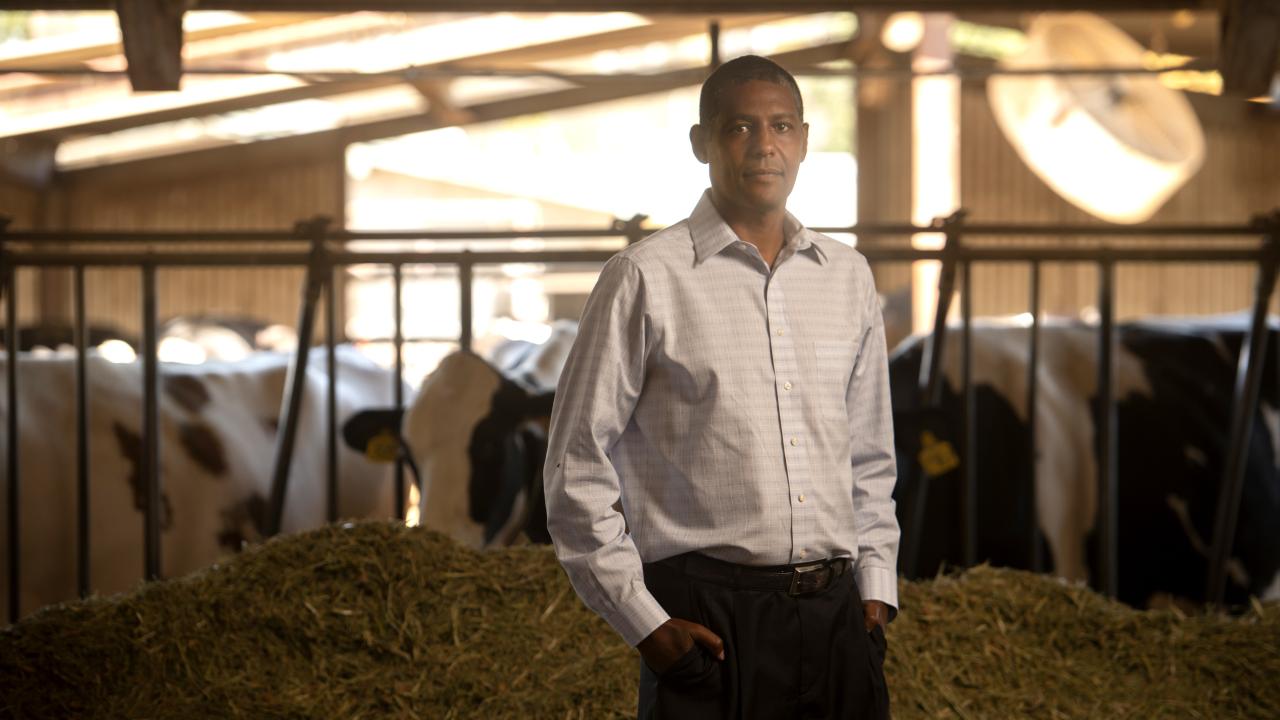
“It’s really looking at the whole system,” said Ermias Kebreab, a professor in the UC Davis Department of Animal Science and a co-author of the study.
Why the study matters
The results point to a possible opportunity to connect two of California’s major agricultural industries.
“California is an especially good place to consider this strategy because the state produces roughly 90% of U.S. wine grapes, so there is a large local supply of grape pomace generated by the wine industry,” Kebreab said. “Instead of treating that material simply as a waste stream, we can potentially use it as a feed ingredient and reduce reliance on some conventional feeds.”
“This is one of the things that makes California agriculture so special,” said Frank Mitloehner, director of the CLEAR Center and a professor in the UC Davis Department of Animal Science. “We have a tremendous diversity of agriculture in this state, and that creates opportunities for them to work together. What might be a byproduct for one industry can become a valuable resource for another.”
Dairy is an important part of California’s agricultural economy, but producing milk also requires resources, including feed, water and land. Finding ways to make dairy feed more sustainable can help reduce the environmental footprint of milk production while making better use of agricultural byproducts that might otherwise go to waste. And because feed production is one source of dairy’s environmental footprint, researchers are exploring ways to replace conventional feed ingredients with alternatives that require fewer resources and generate fewer emissions.
The team compared three diets: a conventional diet, a diet containing 10% grape pomace and a diet containing 15% grape pomace. The analysis considered emissions associated with feed production, cows and manure management, as well as environmental impacts related to water and soil. The analysis estimated that including grape pomace reduced the carbon footprint of milk production by 15.8% with the 10% diet and 19.3% with the 15% diet, compared with the conventional diet.
Enteric methane (cow burps) remained the largest contributor to total greenhouse gas emissions across all three diets. The analysis estimated that including grape pomace reduced enteric methane emissions by 13% to 14% across the production system. Emissions from manure management also declined, with the overall warming impact of those greenhouse gases — measured in carbon dioxide equivalents (CO₂e) — falling 16.8% in the 10% diet and 18.1% in the 15% diet, compared with the control diet.
It's important to note that the researchers did not directly measure methane emissions as part of this study. Instead, they estimated enteric methane emissions using dry matter intake, which is the amount of feed consumed by the cows, as a key factor in their calculations. This approach is consistent with well-established methodologies used by the Intergovernmental Panel on Climate Change. Because cows receiving grape pomace consumed less feed per kilogram of milk produced, the model estimated lower methane emissions.
Looking beyond emissions
While previous research has examined grape pomace's effects on methane emissions, less is known about its broader environmental impacts, including those associated with feed production, water and soil. So, for this study, the researchers also looked beyond greenhouse gas emissions, examining water use, land requirements and the potential for agricultural production to contribute to water and soil pollution.
The analysis found improvements in these areas, too, with the grape pomace diets requiring less water and land and having lower estimated impacts on water and soil quality. For example, water consumption declined by about 21% with the 10% diet and 32% with the 15% diet. Land use decreased by about 18% and 24%, respectively.
These improvements were primarily associated with differences in the production of feed ingredients used in the diet—rather than changes in water use or soil impacts at the dairy itself.
Feed ingredients
The study also highlights the role feed selection can play in the environmental footprint of dairy production. Incorporating grape pomace reduced the amounts of several conventional feed ingredients, including wheat hay and alfalfa hay. Because producing these ingredients contributes to the overall environmental footprint of dairy feed, replacing some of them with an agricultural byproduct can offer benefits beyond reducing emissions from the cow itself.

The researchers noted that a reliable supply of grape pomace will be an important consideration as producers evaluate the use of it in dairy diets. The study did not include transportation costs or emissions in its assessment, and the grape pomace production data were drawn from a French database, due to a lack of local data. Using locally available byproducts could help limit transportation-related impacts, but those benefits would need to be evaluated in future assessments.
“The regional availability is important as well, if the byproduct is produced close to dairy farm, we avoid adding a large transportation burden that could erode some of the environmental benefit,” Kebreab pointed out.
Making better use of agricultural byproducts
Using grape pomace as animal feed offers a way to put an agricultural byproduct to productive use rather than treating it as waste. In regions such as California, where wine grapes are widely grown and processed, this approach could help connect local crop production with dairy farming.
The findings also offer an example of how agricultural byproducts could play a role in making food production more resource efficient.
“I think this is a very good example of circularity in the food system,” Kebreab said. “Ruminants have a unique ability to convert materials that humans cannot eat into nutritious food.”
He added that, “It makes economic sense to farmers using a byproduct instead of expensive ingredients with added benefit of better feed efficiency as well as milk quality.”
“We can't look at sustainability in agriculture through just one lens,” Mitloehner said. “We need to keep asking how we can make better use of the resources we have and find practical ways to improve the way we produce food. Research like this helps us look at the bigger picture and identify opportunities we might potentially overlook.”
For dairy producers, however, Kebreab said the findings should not be interpreted as a recommendation to simply add more grape pomace to a ration.
"The main message is that improving environmental performance does not necessarily have to come at the expense of productivity," he said. "In our study, grape pomace was incorporated at commercially relevant inclusion rates while milk production was maintained. But I would not interpret the results as saying that more grape pomace is always better."
Kebreab emphasized that producers should work with their nutritionists to evaluate whether grape pomace makes sense for their individual feeding programs.
"What I find most significant is that we are seeing benefits across several dimensions at the same time," he said.
He added that, “Grape pomace contains tannins and other compounds that can affect digestion, and finding the appropriate inclusion level and correctly balancing the rest of the ration remains important.”
What comes next?
The next step is to determine how well the findings translate to commercial dairy operations.
Kebreab said he would like to see the strategy tested at a larger scale and over longer periods under commercial dairy conditions. Researchers also need to better understand how grape pomace varies according to grape variety, harvest, winemaking practices and storage, since those differences could affect both methane mitigation and milk quality.
Better California-specific life cycle data, along with a clearer understanding of storage, handling and economics, will also be important moving forward.
“Ultimately, the question is not simply whether grape pomace works experimentally, but where it can be incorporated into commercial feeding systems in a way that makes sense environmentally, nutritionally and economically,” Kebreab said.