



UC Davis Researchers Spotlight Swine Cognition at Conference
At a scientific meeting best known for research on pigeons, rats, primates and even octopuses, pigs also found a place in the spotlight. At least for one session of the meeting.
That session was led by Kristina Horback, an associate professor at the University of California, Davis, and her graduate student Claire Jones at the 33rd annual meeting of the Comparative Cognition Society in Montréal. As the only team presenting on swine cognition, their work drew attention from researchers interested in how individual differences in behavior, such as persistence and reactivity, may influence how pigs engage with and solve problems in their environment.
Founded in 1999, the Comparative Cognition Society (CCS) is a scientific society dedicated to gaining a broad scientific understanding of the nature and evolution of cognition in human and nonhuman animals. Members range from faculty, and animal behavior professionals, to students across fields like psychology, biology, anthropology, applied animal behavior science. The group holds an annual meeting where researchers and their students present their work on comparative cognition in the broadest sense.

Horback and Jones’ presentation entitled, “Persistence, not reactivity determines problem solving in sows,” explored how pigs respond to challenges, both sudden surprises and problem-solving tasks, and what that reveals about their mental state.
The duo examined individual differences in reactivity and problem-solving in 20 adult female pigs (sows) across two time points. They used a “startle test,” where an umbrella was unexpectedly opened near a sow, and then measured involuntary reactions to better understand whether an animal was in a more positive or stressed state.
“It’s a way of getting at how the animal is feeling,” Horback said. “High arousal can mean excitement—or stress. The startle response helps us distinguish between the two.”
They paired this with a simple puzzle box to see how pigs approached problem-solving. What they found was telling: success wasn’t tied to how reactive or “jumpy” a pig was, but rather how persistent it was—how long it stayed engaged and kept trying.
Jones explained the thinking behind the puzzle box test: “We wanted to look at a behavior they could do almost spontaneously. We didn't want to have to train them and have that as a variable,” Jones said. “A lot of puzzle box studies will provide the box open with food and give them hints or even show them how to open it. But we wanted to see if they don't know what's going on, how long does it take them to figure out how to open the box. So, it's much more like trial and error.”
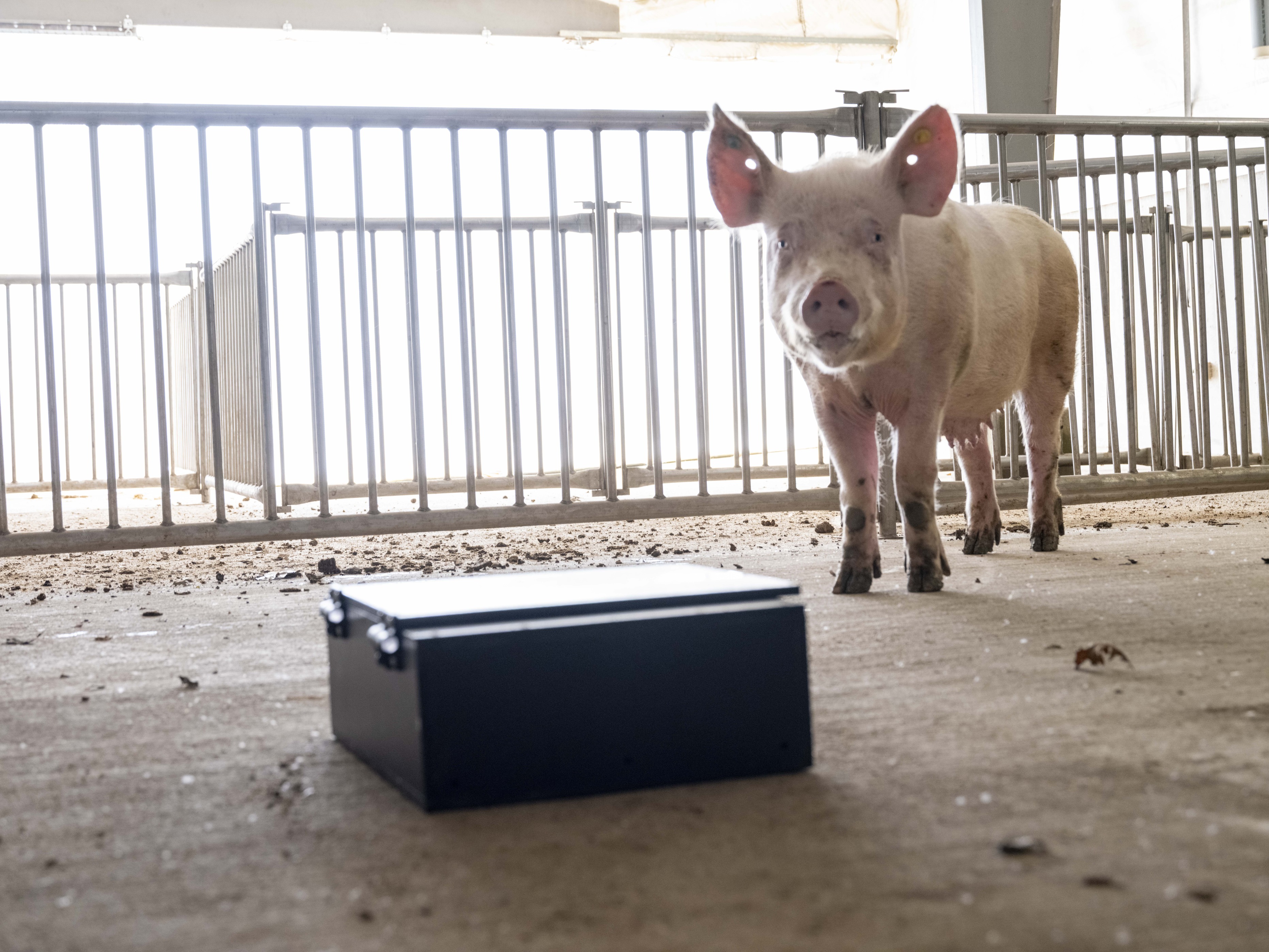
They tracked how quickly the pigs solved the puzzle, whether they succeeded, and how much time they spent interacting with it. The results showed that being more reactive or easily startled did not predict whether a pig would solve the puzzle or how fast it would do so. Instead, the key factor was persistence. Pigs that spent more continuous time actively working on the puzzle were more likely to solve it, while those that only briefly interacted with it—even if they approached it more often—were less successful. In simple terms, success wasn’t about temperament or stress response, but about sticking with the task long enough to figure it out.
Beyond the farm, the research is helping broaden the understanding of animal cognition science. Livestock are still underrepresented in the field, but interest is growing—and Horback and Jones are helping lead that shift.
“There’s so much more to learn,” Horback said. “The more we understand these animals, the better we can design systems that work for them and for the people who care for them.”
And though the two researchers only had about five minutes to present at the conference, their research drew strong interest from attendees.
“They were really interested in the welfare aspect of the research, something that we weren't highlighting as much in the presentation,” Jones said. “One of the pieces of feedback we got is that they really want us to come back and give more welfare and cognition talks. Because a variety of different fields and industries are looking more at animal welfare. So that was exciting to hear.”